The Creator Economy Is Further Along Than Most Investors Realize
Educational Content: This content is for educational purposes only and does not constitute investment advice. All investments involve risk, including potential loss of principal. See full disclosures.
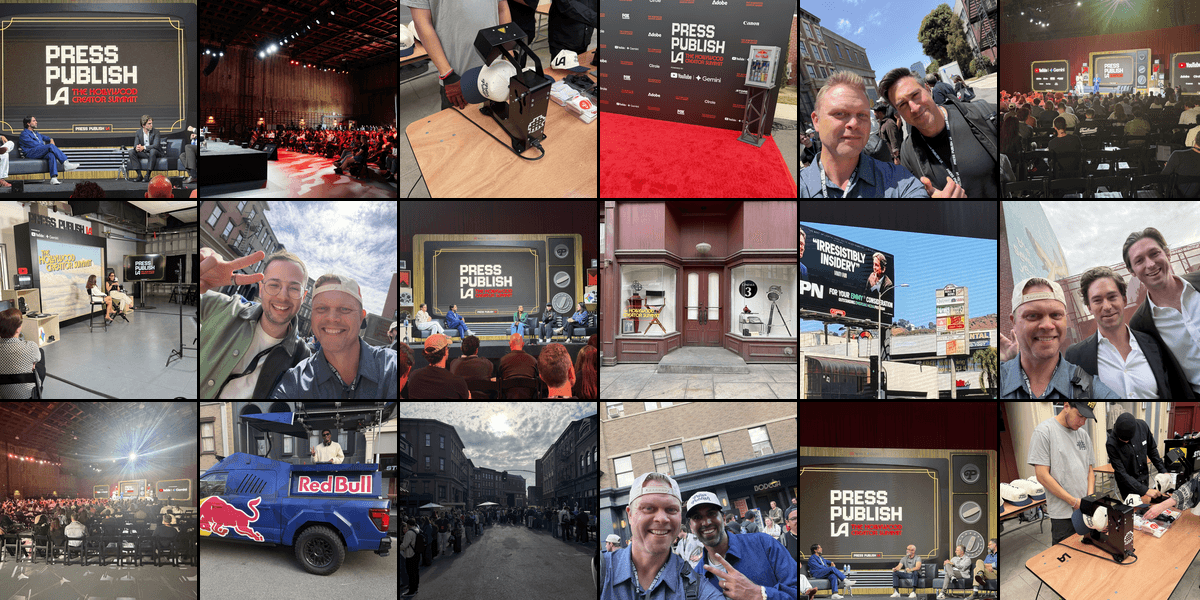
Last week I spent a day on the Fox lot with about 700 Creators, operators, and studio executives at Press Publish LA - Colin and Samir’s second Creator summit. There was a marching band. There was a motorcycle stuntman. Markiplier walked onto the main stage unannounced and the room lost its mind.
So yes - it was a Creator event.
But underneath the spectacle, something happened that I’ve been waiting years to see: Hollywood stopped debating whether Creators matter and started signing paper that admits it.
The deal that tells you everything
The headline wasn’t a keynote. It was a contract.
Fox Creator Studios signed Tom Segura and YMH Studios to a multi-project partnership - a stand-up showcase, an animated horror series, live-action comedy - with Fox and YMH splitting ownership.
Read that again. Not a licensing deal. Not a development deal where the studio owns everything and the talent gets a check. Split ownership.
And here’s why Fox took those terms: YMH doesn’t need them for reach. Segura’s network already generates 500 million impressions a year from fans who pay him directly. Fox is bringing production muscle and ad dollars. The audience - the thing that used to be the studio’s entire leverage - belongs to the Creator.
For seventy years, the deal was: talent makes the thing, studio owns the audience. That deal is dead. The studio showed up as the service provider. When you see that happen on the Fox lot, in public, you’re not watching a trend. You’re watching a repricing.
Markiplier’s P&L would make a studio exec weep
The other moment that stuck with me: Markiplier talking about being “addicted to overcoming that doubt” - and then casually mentioning that his film Iron Lung did $52 million across 4,200+ theaters on a budget under $5 million.(Source) While releasing it on YouTube the same day.
Ten-x-plus return on a first feature, day-and-date on a free platform, Creator-owned IP the whole way through. I’ve sat across the table from a lot of founders and a lot of studio people. Nobody in either room has economics like that.
And the rest of the day sounded the same. Johnny Harris - fresh off an Emmy - talked about building reliability first, then investing in development for The Human Element. John Coogan made the case that content is a barbell: be timely or be timeless, but the daily shipper beats the weekly perfectionist because they’re learning faster. Michelle Khare described cutting her seven-marathons series three different ways before the format held its emotional core. Beast Industries’ Kara McCloud framed MrBeast’s operation as the talent incubator this industry never had.
Notice what’s missing from all of that? Nobody talked about going viral. They talked about formats, development budgets, shipping cadence, and talent pipelines. These people talk like operators now, because that’s what they are.
I’ve seen this movie before
Here’s where the investor part of my brain takes over - because I started as a Creator, became an operator, and now I underwrite this market for a living. And the pattern at Press Publish is one capital markets have run twice already.
Music royalties were a curiosity until the Bowie Bond, then a niche, then suddenly Blackstone was backing Hipgnosis and Concord was closing a $1.7 billion+ securitization. (Source) Sports franchises were trophy assets until the NFL opened to private equity in 2024 - the average franchise now sits north of $7 billion. In both cases the institutions weren’t buying glamour. They were buying recurring cash flow tied to audiences that don’t stop showing up in a downturn.
Creators are the same asset wearing a hoodie. YouTube did $60 billion in revenue last year - a third bigger than Netflix - and has paid Creators over $100 billion since 2021. More than a thousand US Creators now earn over $1 million a year in platform-reported revenue. Not estimated. Reported. Daily analytics, verified monthly payouts, real audience data. I’ll say the quiet part: an established Creator’s revenue is easier to diligence than most mid-market loan books.
The honest version of the opportunity
Most coverage of the Creator economy quotes the 3 million channels in YouTube’s partner program and calls it a market. That’s not a market - that’s a haystack.
Strip out the music labels and VEVO channels - about $8 billion of YouTube’s annual payouts go to the music industry, not human Creators (Source), the brand accounts, the kids-content factories, and the hobbyists, and the real investable universe is roughly 5,000 to 8,000 US-based, human-operated Creator businesses earning meaningful, recurring, verifiable revenue - drawing on a US Creator ad pool of about $5–6 billion a year. (Source) Before sponsorships, memberships, merch, courses, or events.
Smaller number. Much better story. Because what’s left after the filter are businesses with 50–70% margins, global distribution, near-zero customer acquisition cost, and audiences they actually own. The opportunity isn’t that this market is huge. It’s that it’s real - and still almost completely unbanked.
What we’re building at GigaStar
This is the part where I tell you what I do, so consider this your disclosure.
At GigaStar, we’ve spent three years building the financial rails for exactly this: revenue-sharing instruments that let investors participate in a Creator’s revenue - while the Creator keeps 100% of their channel, their brand, and their creative control. On the retail side, fans have been investing alongside Creators through GigaStar Market since 2023 - 38 channel offerings and over $1.1 million in Creator revenue already distributed back to investors, with the first secondary trading system for Creator revenue securities. And through a Creator Revenue Fund set up through GigaStar Capital, we’re bringing the same asset to institutional investors at fund scale - the same playbook that turned music catalogs and sports franchises into portfolio allocations.
I didn’t come to this as a financier. I came to it as a Creator who learned the hard way that attention without ownership is a treadmill. That’s exactly why the Fox–YMH deal matters: it’s the industry conceding, in writing, that the audience belongs to the person who built it.
Ownership is the whole story now
My biggest takeaway from Press Publish LA isn’t any single session or announcement. It’s that every conversation on that lot - Creator, studio, or investor - eventually arrived at the same word: ownership.
Who owns the audience. Who owns the IP. Who owns the cash flow. The Creators already answered the first two. The next decade of this industry is about the third - and about building the infrastructure that lets everyone else participate in it honestly.
Hollywood validated Creators last week. The capital markets are next. We intend to be early -mostly because, for once, we already are.
If you’re a Creator who's curious about how we can help fund your channel goals, book a call with our Partnerships team.
Cited Sources:
“Markiplier talking about being “addicted to overcoming that doubt” - and then casually mentioning that his film Iron Lung did $52 million across 4,200+ theaters on a budget under $5 million.” --- https://www.instagram.com/reels/DY8CXLzxeuC/
“Blackstone backing Hipgnosis and Concord was closing a $1.7 billion+ securitization --- “https://www.blackstone.com/news/press/blackstone-leads-landmark-music-abs-transaction-hipgnosis/
“About $8 billion of YouTube’s annual payouts go to the music industry, not human Creators.” --- https://blog.youtube/news-and-events/8-billion-youtubes-twin-engine-continues-to-fuel-the-future-of-music/
“roughly 5,000 to 8,000 US-based, human-operated Creator businesses earning meaningful, recurring, verifiable revenue - drawing on a US Creator ad pool of about $5–6 billion a year.” --- https://www.forbes.com/sites/jasondavis/2026/01/26/the-creator-economy-in-2026---the-era-of-consolidation/
This communication is provided by Creator Networks, Inc. (dba GigaStar). GigaStar is the parent company of GigaStar Portal, LLC (dba GigaStar Market), an SEC-registered funding portal member of FINRA, and GigaStar Technologies LLC, offering blockchain and smart contract solutions via GigaStar Portfolio. GigaStar Securities LLC (dba GigaStar Trading) is an SEC-registered broker-dealer and member of FINRA/SIPC. Secondary trading is conducted via GigaStar Securities’ SEC-registered ATS. The ATS will only trade Digital Asset Securities.
Investment offerings are speculative, illiquid, and involve a high degree of risk, including the risk of loss of your entire investment. Past performance is not a guarantee of future results. There is no guarantee of an active or liquid secondary market, and investments are subject to market risk and will fluctuate in value. Investors may not be able to find a buyer, or the sale price could be much lower than the amount invested.
Neither GigaStar nor any of its affiliated companies provides legal, regulatory, financial, or tax advice. Any opinions expressed herein are those of the author(s) and are for informational purposes only. The information and opinions expressed herein are subject to change without notice and do not take into account the particular investment objectives, financial situation, or needs of any specific investor(s).
Additionally, any factual content in this material was obtained from sources believed to be reliable, but we do not warrant the accuracy or completeness of any information contained herein and provide no assurance that this information is, in fact, accurate.
Projections are inherently subject to substantial and numerous uncertainties and to a wide variety of significant business, economic, and competitive risks, and the assumptions underlying the projections may be inaccurate. Forward‐looking statements are not guarantees of future performance, and the reader is cautioned not to place undue reliance on forward‐looking statements.
The content herein does not constitute a solicitation of an offer to buy security(ies).